
August 2025
Editor: Manasvee Saraf
Foreword
MANASVEE SARAF
Welcome to the August 2025 edition of the WALLABY newsletter! The past six months have seen steady progress across several fronts, with efforts focused on addressing technical challenges in the observing strategy and data processing, storage and access. The kinematic pipeline is now in active use, and two new papers using WALLABY data have been accepted for publication.
In this issue, the PIs provide an update on survey completeness and ongoing technical developments. The project scientist welcomes the new deputy project scientist and highlights the steady flow of WALLABY publications and invites members to support survey data validation efforts. The project manager outlines recent progress in observing and source-finding strategies. We are pleased to welcome four new members who have joined the team since February 2025. In the science updates, Tamsyn O’Beirne discusses her newly accepted paper on HI-selected dark sources and low surface brightness galaxies, while Nathan Deg shares highlights from his recently submitted work on low-rotation galaxies. From the technical working groups: TWG 5 reports on progress with the kinematic pipeline and their upcoming workshop, TWG 6 invites members to help beta-test their data visualisation system, and TWG 7 provides updates on the WALLABY database access. As always, we encourage all members to get involved in ongoing projects, upcoming meetings and workshops!
Happy reading !
Message from the PIs
LISTER STAVELEY-SMITH & BARBARA CATINELLA
Progress of WALLABY observations has been slower than anticipated, with only 6% of the survey completed after two years of full operations. This is due to a combination of factors, including earlier issues with the Setonix supercomputer at the Pawsey Centre (now resolved), solar interference, and limitations in the ASKAP calibration and spectral line pipeline, which currently restricts the accessible sky area to ~20% of our footprint — mainly away from strong continuum sources.
Prompted by our growing concern and the lack of clarity around future timelines, we sent a letter to Australia Telescope National Facility (ATNF) leadership on 5 May, co-signed by the PIs of several other spectral line survey science projects (SSPs). This led to a consultation process with the SSP teams, and a commitment from ATNF to provide more transparent planning and updates.
While the situation is still evolving, recent updates have been encouraging. WALLABY has been allocated 128 hours of observing time between 26 July and 25 August 2025. In parallel, key technical updates — including reference field calibration, offset source removal, and firmware upgrades — are on track to enable a full restart of spectral line survey observations in August or September. ATNF has also established a webpage to provide monthly updates on the ASKAP system.
The revised timeline now projects completion of WALLABY in 2029. While the road ahead remains challenging, these recent developments are promising — and we’ll continue to keep you informed as the situation evolves.
Message from the Project Scientist
KAREN LEE-WADDELL
I am happy to announce that we have a new WALLABY Deputy Project Scientist, Jonghwan Rhee. With his new Research Scientist position at CSIRO — working with the ASKAP team — Jonghwan is well placed to help solve technical issues affecting ASKAP spectral line data.
Although observations have been progressing slowly with intermittent pauses, WALLABY science papers are being published in a steady flow (see Fig. 1). The 6% (550+ hours) of full science observations still provide a wealth of research potential. The Universe is full of questions waiting for us to explore, so let’s see where our curiosity can take us!
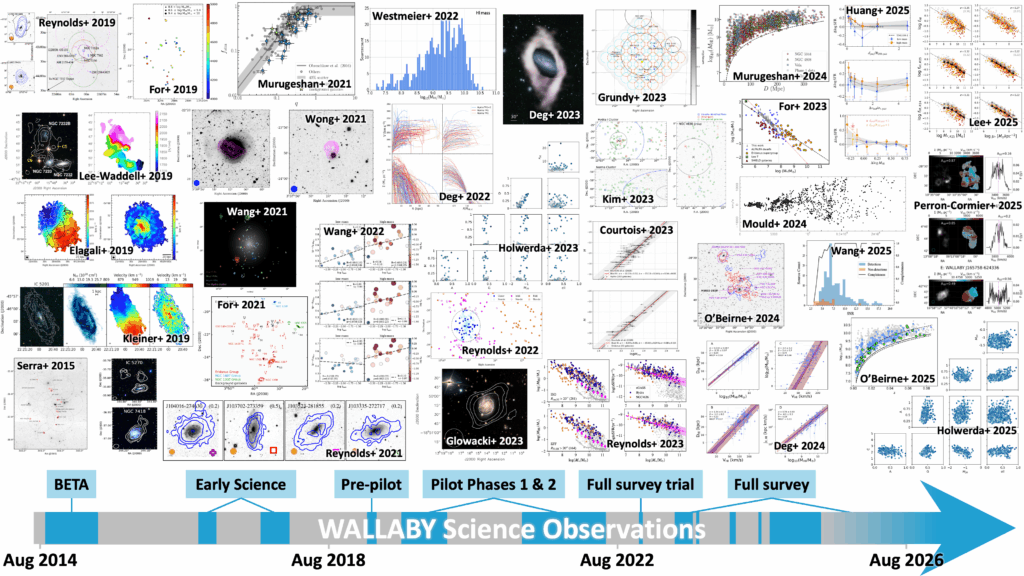
Figure 1: Timeline of WALLABY science papers and observations. The blue sections of the timeline arrow indicate periods of active WALLABY observations whereas the grey sections show pauses.
With the aforementioned updates to the ASKAPsoft processing pipeline, it would be great to have more eyes on the data to verify that the newly added processing techniques are working properly. We also need people to do general checks of the data by looking at standard quality control metrics. If you would like to further contribute to survey efforts, please consider helping out with WALLABY data validation and contact me for more details.
WALLABY progress update
by Tobias Westmeier
A total of 69 WALLABY survey footprints have been successfully observed and deposited into the CSIRO ASKAP Science Data Archive (CASDA) so far (as of June 2025), thus taking the survey completeness to just over 6%. A map showing the current sky coverage is shown in Fig. 2. Due to interference from the active Sun, WALLABY observations are now being conducted during the night which has significantly improved the quality of our data and has resulted in a near-100% acceptance rate of new data.
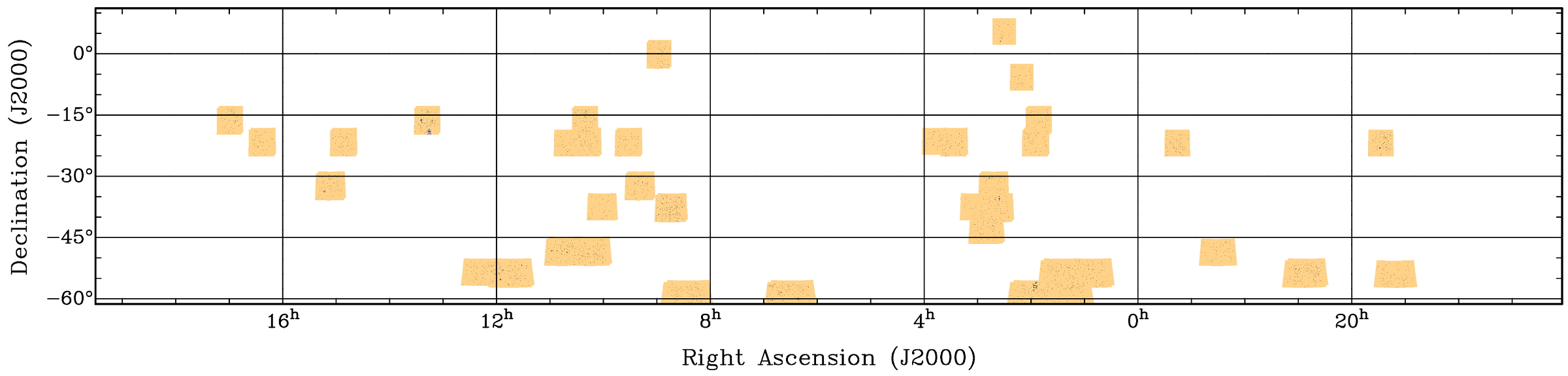
With full survey observations progressing, the WALLABY source finding pipeline continues to produce source catalogues and data products for the inner 4° × 4° regions of all full 16-hour tiles, where we already reach the full sensitivity of about 1.6 mJy RMS. In addition, a few contiguous regions of multiple adjacent tiles have been completed (see Fig. 2), allowing us to additionally run the source finder on the overlapping regions in between neighbouring tiles.
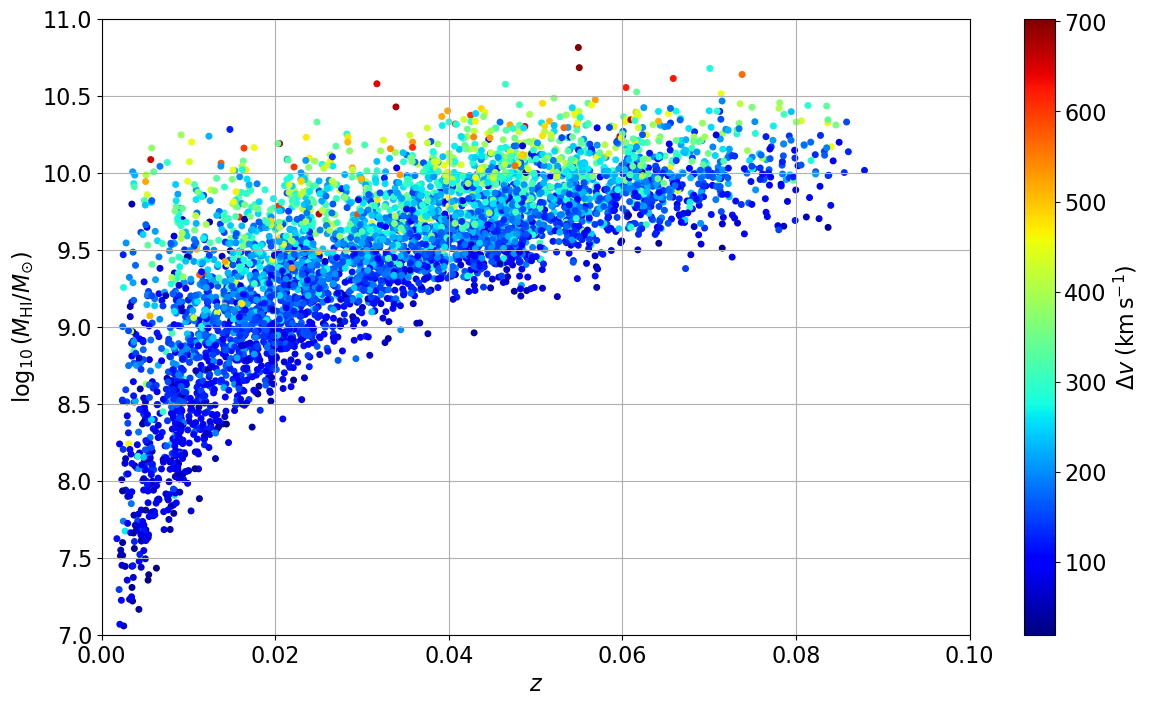
As of June 2025, almost 2400 HI detections from full survey observations have been internally released to the team and are available from the Australian SKA regional centre (AusSRC) source database using the “WALLABY” tag. Combined with the pilot survey data, about 4700 galaxies are now available to the team for scientific analysis (Fig. 3) which represents an unprecedented sample of spatially resolved HI detections of galaxies. Team members can access the data using the new Jupyter notebooks available on GitHub. The current access credentials can be retrieved from the internal Redmine wiki.
The WALLABY source database was successfully migrated to a new server recently and is now available again to all team members. We will continue to release sources and source data products (images, spectra, kinematic models, etc.) to the team over the coming months and years as survey observations progress.
New Member Profiles
Benjamin Oppenheimer

Hello WALLABY Team. My name is Benjamin D. Oppenheimer and I am a researcher at the Center for Astrophysics and Space Astronomy (CASA) at University of Colorado (CU), Boulder, specialising in cosmological simulations of the circumgalactic medium (CGM) and galaxy evolution.
Using cosmological hydrodynamical simulations, particularly the Evolution and Assembly of GaLaxies and their Environments (EAGLE) suite, my work connects observational gaseous signatures from instruments like the Cosmic Origins Spectrograph (COS) to the underlying dynamical processes governing galaxy growth and evolution—such as gas accretion, outflows, and hot halo formation. I am especially interested in understanding how star formation is quenched in passive galaxies, in studying the role of supermassive black holes in feeding back upon gaseous halos, and in quantifying the diffuse gas surrounding galaxies of all types, across various environments, from field to massive clusters. My research spans the full electromagnetic spectrum, from the radio to the X-ray, and a wide redshift range, from the present-day Universe to the Epoch of Reionization.
The reason I have joined WALLABY is that my students and I are generating mock 21-cm HI maps using IllustrisTNG simulations and feeding them into Machine Learning tools to determine the value and information content of deep HI mapping extending beyond galaxy disks and into the CGM. I am especially eager to learn how we can determine key quantities of the CGM from WALLABY observations combined with the extended ROentgen Survey with an Imaging Telescope Array (eROSITA) all-sky survey in the soft X-ray. Please stay tuned to an upcoming paper by previous CU undergraduate (and incoming University of California, Los Angeles graduate student) Kalvyn Adams.
Brenda Namumba

I am a radio astronomer specialising in galaxy evolution through HI studies. I earned my PhD in Astrophysics from the University of Cape Town in 2019. Currently, I am a Research Fellow at the Instituto de Astrofísica de Andalucía (IAA-CSIC) in Granada, Spain.
My research focuses on the gas dynamics of nearby galaxies using SKA precursor instruments such as MeerKAT, contributing to large survey projects like MeerKAT HI Observations of Nearby Galactic Objects – Observing Southern Emitters (MHONGOOSE). Beyond my research, I am passionate about science communication and mentoring emerging African scientists in astronomy.
I bring to WALLABY a strong background in HI science, with expertise in spectral line data analysis, continuum subtraction, and the interpretation of gas dynamics in nearby galaxies. My experience with SKA precursor instruments, particularly MeerKAT, through large survey projects such as MHONGOOSE, allows me to contribute a complementary perspective to the study of galaxy evolution within WALLABY.
Qifeng Huang

Hello! I’m Qifeng Huang, a PhD student at Peking University, China. My research focuses on galaxy evolution, particularly the role of tidal interactions and mergers in shaping star formation. To study these processes, I analyse multi-wavelength observations, such as optical imaging, spectroscopy, and HI 21 cm data from WALLABY and the Five-hundred-meter Aperture Spherical radio Telescope (FAST).
One of my key contributions is the development of a 3D deblending technique for WALLABY data that helps isolate HI emission in closely interacting galaxy pairs. Currently, I’m analysing the shapes of integrated HI spectra and their relation to the spatial distribution of HI gas. I’m also studying the spectral energy distributions (SEDs) of nearby galaxies to understand their connection with the HI gas reservoir.
I’m excited to join the WALLABY collaboration and leverage this incredible dataset to explore how HI gas responds to and drives star formation in galaxy mergers. I’m eager to collaborate with and learn from the team.
Roger Ianjamasimanana
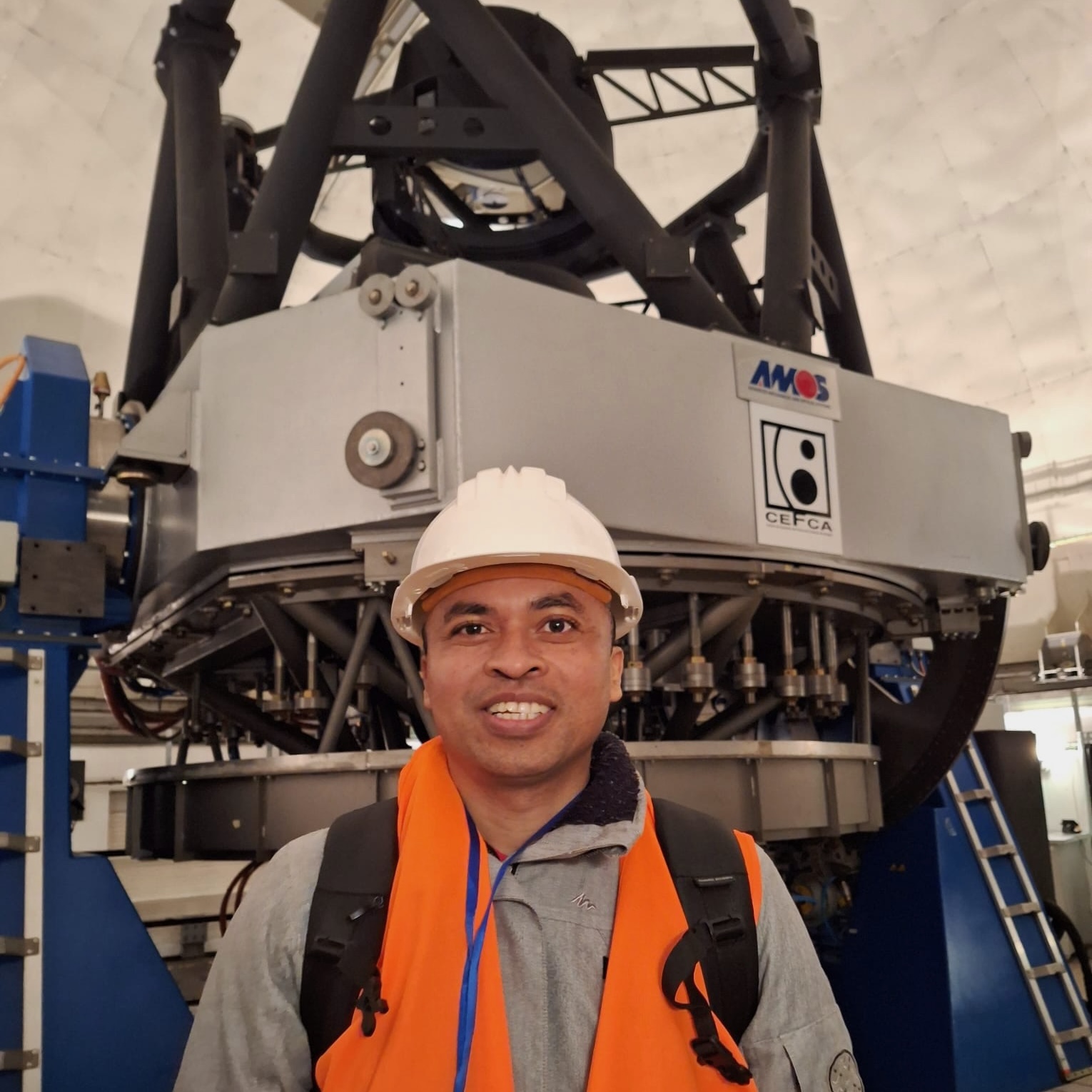
Hello! My name is Roger Ianjamasimanana. I am currently a postdoctoral researcher at IAA-CSIC in Granada, Spain. I completed my PhD at the University of Cape Town, South Africa, where my research focused on the interplay between gas and star formation in nearby galaxies.
I am mainly interested in understanding secular processes and the role of the environment in galaxy evolution. Over the past few years, I have used data from MeerKAT to find signs of ram pressure stripping in nearby isolated dwarf galaxies, study their kinematics and dark matter properties, and understand the evolution of compact groups.
I recently joined the WALLABY collaboration to contribute to research on compact groups and isolated galaxies.
Properties of HI-selected dark sources and low surface brightness galaxies
by Tamsyn O’Beirne
Optically dark HI sources are particularly intriguing, as they can offer insights into the mechanisms that suppress star formation, the role of galaxy interactions and resolving cosmological tensions. Their lack of optical emission means that we require untargeted HI surveys to detect them. With WALLABY’s improved resolution and sensitivity over previous widefield HI surveys, we now have a unique opportunity to systematically study these extreme objects.
In a paper recently accepted for publication in PASA, we examine the optical counterparts of the 1829 HI detections in three WALLABY pilot fields using data from the DESI Legacy Imaging Surveys data release 10 (DR10). We find that 17% (315) of the detections are optically low surface brightness galaxies (LSBGs; mean g-band surface brightness within 1 Re of > 23 mag arcsec-2). These gas-rich WALLABY LSBGs have low star formation efficiencies, and have stellar masses spanning five orders of magnitude, which highlights the diversity of properties across our sample. 75% of these LSBGs had not been catalogued prior to WALLABY.
In addition to the LSBGs, we identified 55 optically ‘dark’ HI sources. We assess these HI detections without optical counterparts and identify 38 which pass further reliability tests. Of these, we find that 13 show signatures of tidal interactions. The remaining 25 detections have no obvious tidal origin, so are candidates for isolated galaxies with high HI masses, but low stellar masses and star-formation rates. Fig. 4 shows an example of one such source. The left panel shows the g-band image with HI contours overlaid, revealing no optical counterpart. The right panel presents the moment 1 map for this source, with a velocity gradient visible.
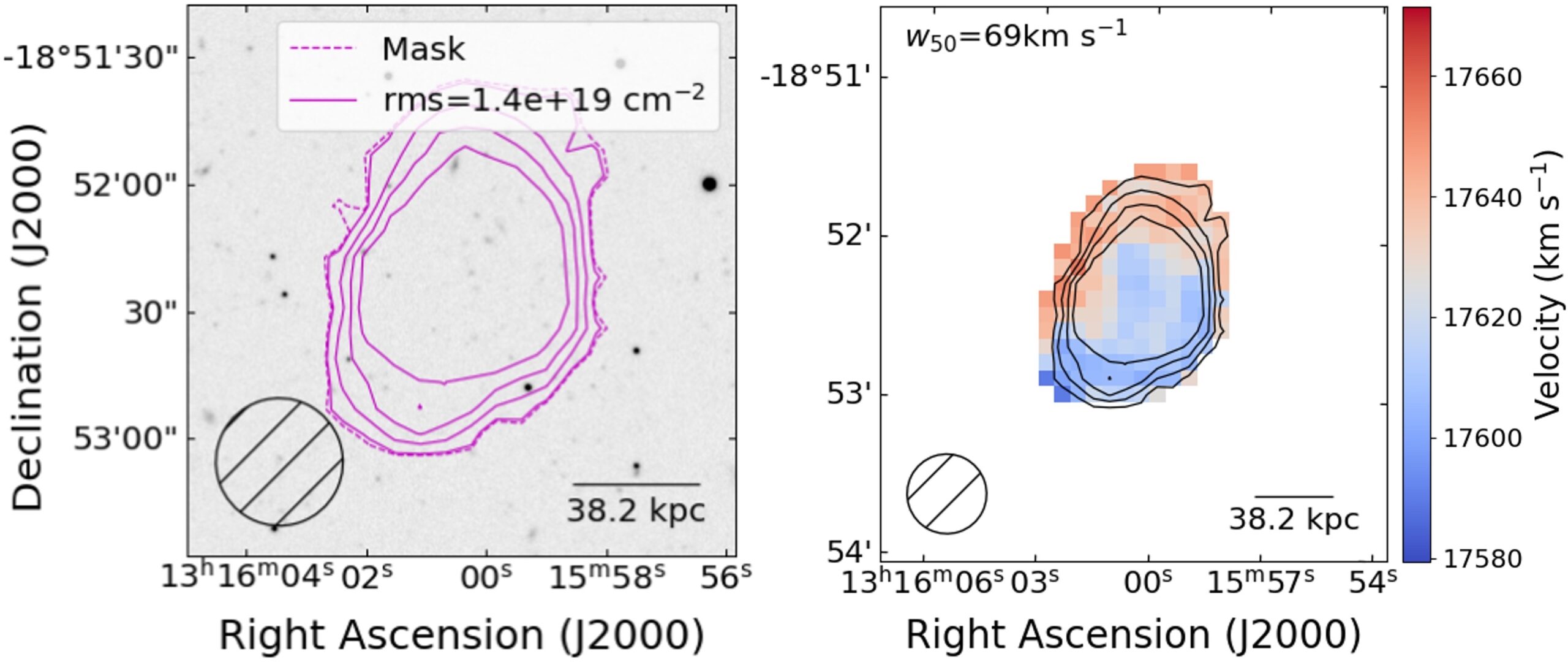
We have MeerKAT follow-up observations of 8 of the relatively isolated dark sources and 2 dark tidal clouds that we are currently reducing and analysing. Additionally, a proposal to follow up the remaining sample has been submitted in the current MeerKAT cycle, so stay tuned for future results!
Characterising Low Rotation Kinematically Modelled Galaxies from the Pilot WALLABY Data Releases
by Nathan Deg
One of the core goals of WALLABY is building a statistical sample of low rotation velocity galaxies. These are necessary to probe the velocity function, the low mass end of the baryonic Tully Fisher Relation (bTFR) as well as other scaling relations, and to understand the dark matter content of low mass galaxies. While surveys like Arecibo Legacy Fast ALFA (ALFALFA) and HI Parkes All Sky Survey (HIPASS) have probed this regime with single dish, unresolved observations, only WALLABY has the combination of sensitivity and resolution to build a sample of resolved and kinematically modelled low rotation galaxies.
The first 2 WALLABY pilot data releases include kinematic models for 236 galaxies. 11 of these galaxies have rotation velocities below 50 km/s, which fall squarely into the low rotation regime. Moreover, 9 of these have deep optical observations available from DECaLS (see Fig. 5). In our recently submitted paper we decided to look at these in more detail as well as explore the challenges faced when modelling in the marginally resolved, low signal-to-noise ratio (S/N), low rotation regime in general.
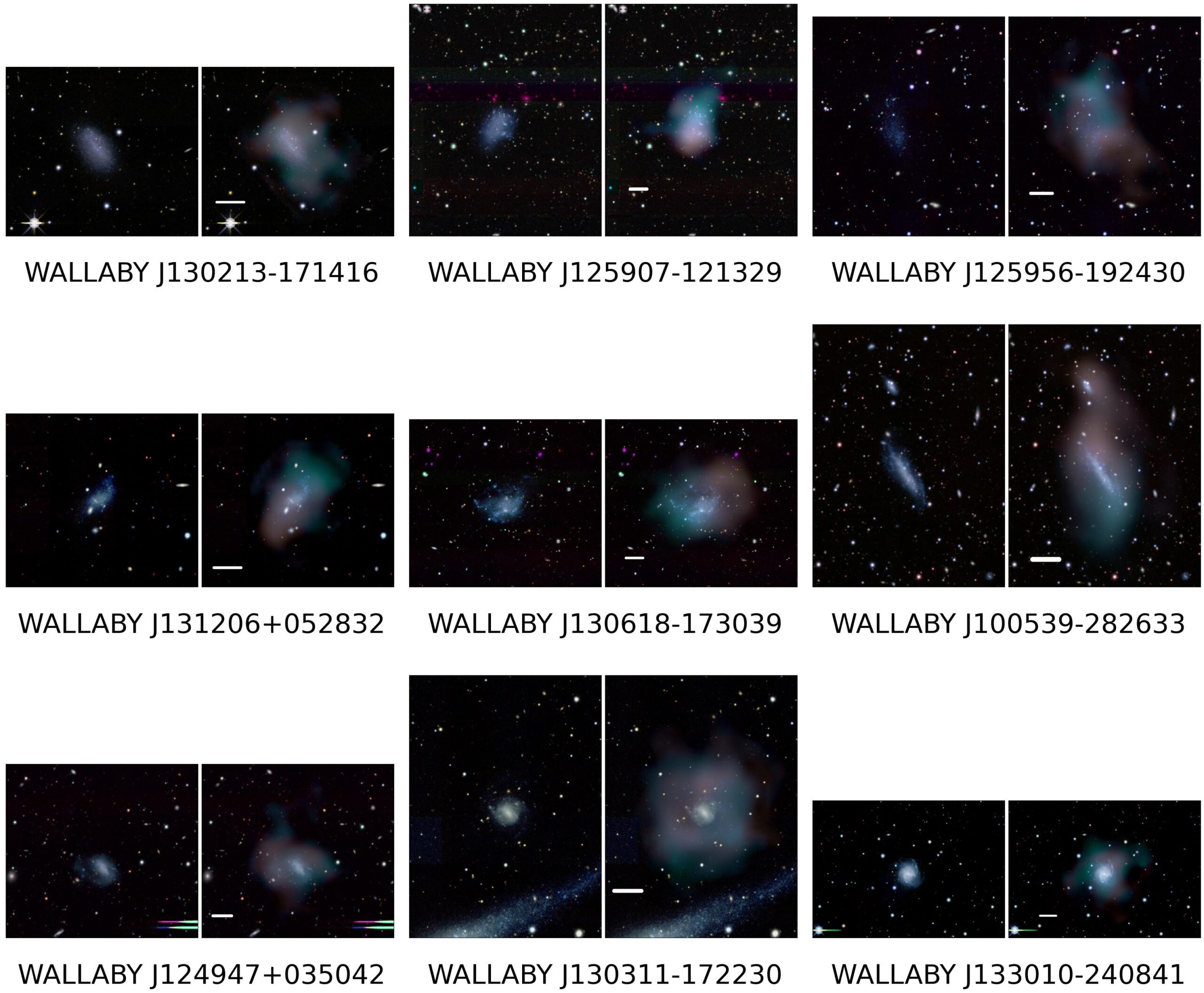
Through extensive testing with mock galaxies, we found that the WALLABY approach of averaging together fits from both the 3D-Based Analysis of Rotating Object via Line Observations (3DBAROLO) and Fully Automated TiRiFiC (FAT) kinematic modelling codes yielded much more reliable rotation curves and surface density profiles than either of those (or other) codes alone. However, even with this improvement, models with measured inclinations below 40° remain unreliable.
Upon examining the WALLABY models, we found all the galaxies to be consistent with the HI size-mass relation. Those with well measured inclinations are also consistent with scaling relations like the bTFR. But those with lower inclinations tend to lie off these relations. When we considered the optical observations, the reasons for the failures became clear. Most of those galaxies with low inclinations are face-on spirals. And, in some other cases the optical and kinematic inclinations are very different. Most interestingly, one of the detections actually consists of two different galaxies that are aligned in such a way as to appear as a single rotating disk in HI. In that particular system, the secondary is much lower mass, which is why it remains close to the scaling relations that we explored.
Ultimately, we found that it is indeed possible to reliably model galaxies in the marginally resolved, low S/N, low rotation regime above 40°. This bodes well for the ability of WALLABY to resolve long standing questions and tensions in the HI velocity function, probing the bTFR, and studying the dark matter content of low rotation galaxies.
TWG 5 – Kinematics Pipeline
by Kristine Spekkens
Work continues within TWG5 to apply flat-disk 3D structural models to WALLABY detections. In addition to the pilot survey kinematic models (publicly released in Deg et al. 2022 and Murugeshan at al. 2024), which average the outputs of two existing codes to estimate the best structural model and its uncertainties, models for ~300 galaxies using the tailored 3D-KInematic Data aNalysis Algorithm for Surveys (3KIDNAS) code are now available internally to the WALLABY team, with ~200 more in the process of being internally released. Major activities for TWG5 in the coming months include drafting a publication for 3KIDNAS, continuing to develop its capabilities, and exploring alternative modelling techniques for subsets of WALLABY survey detections (e.g. well-resolved systems).
For WALLABY team members attending the Pathfinder HI Survey Coordination Committee (PHISCC) workshop in Cagliari this September, there will be a kinematic modelling breakout session that will cover a variety of codes and projects, along with time for discussion and opportunities to participate in software demos. Please stop by if you are interested!
TWG 6 – Data Visualisation
by Marcin Glowacki
The Pawsey Visualisation Lab system in Perth for RemoteVis, which allows users to log into the Nebula supercomputer system remotely, has recently had an upgrade. A new persistent storage system, Randia, has now been implemented – providing uninterrupted access to the data. The ongoing Pawsey visualisation project for Remote/CloudVR streaming of WALLABY datasets through immersive Data Visualisation Interactive Explorer (iDaVIE) has also been migrated across, and so we should be able to take advantage of Randia.
We’re currently looking for Perth-based helpers for this project! If you are interested in helping beta test this system (be it from the visualisation lab or from University of Western Australia/Curtin University/elsewhere!), or have datasets (even hundreds of GB large!) that you’d like to have tested in this CloudVR streaming setup, please let me (Marcin Glowacki) know, so you can be added to this Pawsey project. See here for more details.
Looking ahead, at the PHISCC workshop this September, there will also be a VR hands-on demonstration during the breakout sessions. More information on that will be made closer to the date by the organisers, but it will be possible for you to bring and view your own datasets. Consider what files you’d like to see in 3D while at the workshop!
TWG 7 – WALLABYcat
by Nathan Deg
The WALLABY database has been successfully migrated to a new server and is available to the entire team. Moreover, the database can now be accessed through Table Access Protocol (TAP) services. To enable easier access, there are updated notebooks (available here) that allow users to interact with and download the ~5000 unique WALLABY detections. Additionally, all 236 pilot kinematic models are available, and ~500 3KIDNAS kinematic models are, at the time of writing, being uploaded. These should be available to the team by or shortly after the publication of this newsletter.
Upcoming Meetings & Workshops
Note: WALLABY team members can download PDF copies of several WALLABY-related presentations at international meetings from the internal Redmine wiki under “WALLABY-related presentations and material”.
| What | When | Where |
| 2025 Aug 21 | Monthly WALLABY Science Meeting* | Online |
| 2025 Aug 18-21 | Hungry HIppos: HI Workshop | Kruger Park, South Africa |
| 2025 Sep 22-26 | PHISCC Workshop 2025 | Cagliari, Italy |
| 2025 Sep 23-26 | CL2025: Entering a Golden Age of Galaxy Cluster Studies | Taipei, Taiwan |
| 2025 Oct 6-10 | Multi-phase, Multi-temperature and Complex | Olbia, Italy |
WALLABY Publications
Feb 2025 – Aug 2025:
- O’Beirne T., Staveley-Smith L., Kilborn V.A., Wong O.I., Westmeier T., Cluver M., Bekki K., et al., 2025, WALLABY pilot survey: Properties of H I-selected dark sources and low surface brightness galaxies, PASA, 42, e087. doi:10.1017/pasa.2025.10047
- Lee S., Catinella B., Westmeier T., Cortese L., Wang J., Spekkens K., Deg N., et al., 2025, WALLABY pilot survey: Spatially resolved gas scaling relations within the stellar discs of nearby galaxies, PASA, 42, e046. doi:10.1017/pasa.2025.30
A complete list of WALLABY ADS libraries can be found at https://wallaby-survey.org/papers
WALLABY Science Projects
Team members are reminded to regularly check the list of Current Projects list, linked on the internal Redmine wiki. If you are interested in contributing to any of these existing science projects, please feel free to get in touch with the PI of the project in question.